Why this exists
I wanted a concise way to see what the optimal values are for the nutrients I care about, and to drop my own numbers in against them. I’d been optimizing my health on and off for years, and the reference values were always scattered: one range on the lab report, a different one on a longevity blog, a third in a forum.
I assumed pulling those together would be a long, manual slog. It turned out that using AI to consolidate the values concisely and wrap them in a clean UI was the easy part.
What it does
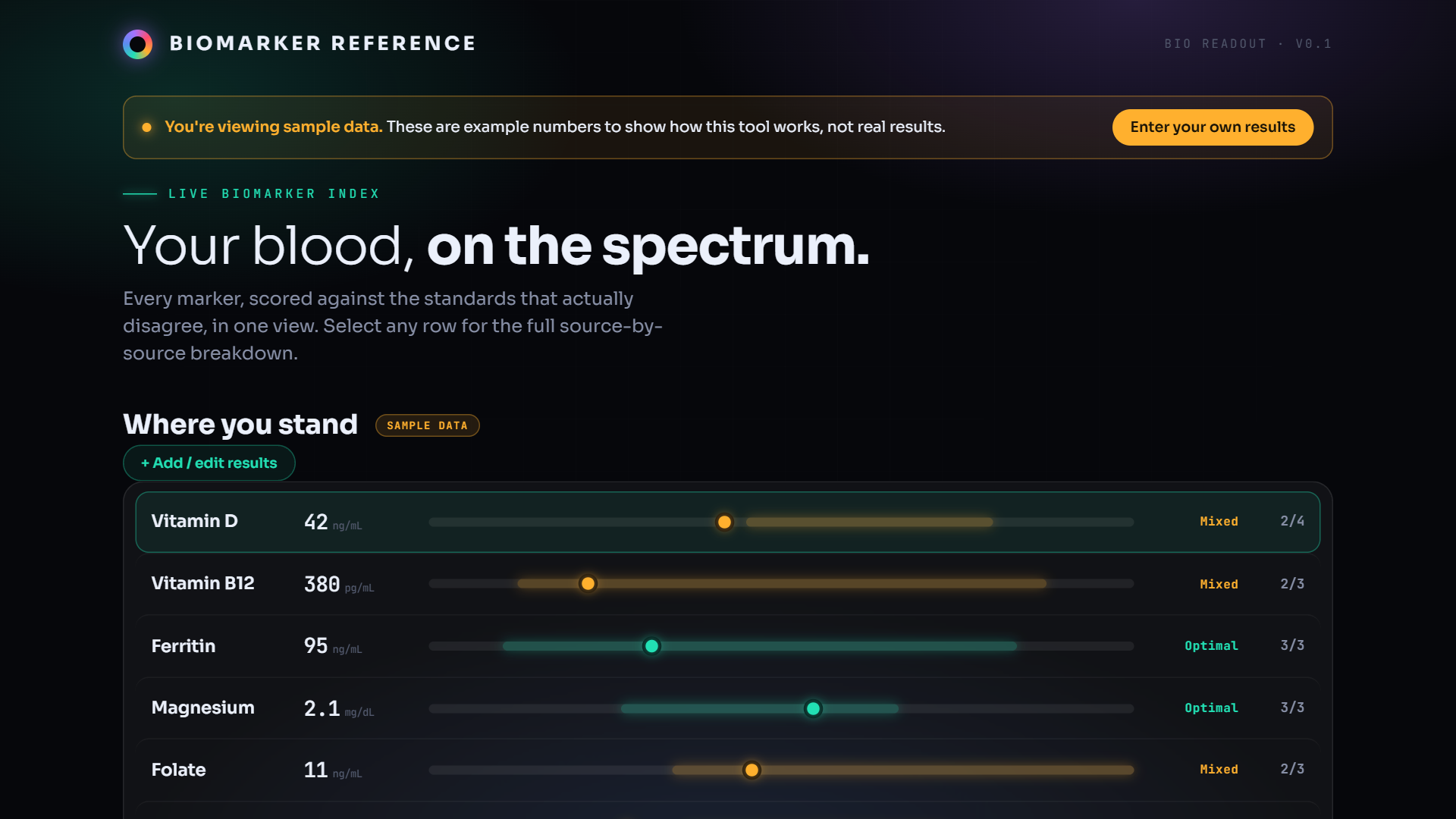
- Shows a panel of biomarkers (vitamins, minerals, and a few cardiometabolic markers) with real, cited reference ranges
- Scores each value against multiple standards at once: a conventional lab range, a clinical guideline, a functional-medicine target, and the Blueprint longevity protocol
- Tells you honestly when the standards disagree, “Mixed” instead of a fake-confident “Optimal” when only some sources agree
- Adds a population-percentile read (where you sit among US adults) for the markers with solid NHANES data
- Lets you type your numbers in or paste a lab report and have it auto-fill, all on your device
It opens on clearly-labeled sample data so the page is never empty, and the moment you enter a real value, the sample disappears.
How it works
- Catalog: Every marker and every source’s range live as plain, cited data, so adding a nutrient or a new standard is a data edit, not a code change
- Score: A small pure function places your value against each source’s band and returns a verdict (optimal / below / elevated), with a separate rule for “lower is better” markers like ApoB
- Render: A vanilla-TypeScript island draws the overview chart and the per-marker dial in SVG, no chart library
- Persist: Your values stay in the browser’s local storage, nothing leaves the device on the manual path
The whole thing is a static site, which keeps it free to run. The one feature I cut for that reason was AI lab-report parsing: a deployed app can’t use my Claude subscription, and the metered API would cost real money per parse, so I replaced it with a free in-browser parser that handles the common cases. Every range is sourced and cited (LabCorp, the Endocrine Society, NIH, WHO, NHANES, and others), and a test fails the build if any range ships without a citation.
What’s next
- Attach actual supplement recommendations. If you want to raise your Vitamin D by 10 ng/mL, what supplementation does that take, and which brands are considered reliable
- More markers and more sources, since the catalog is built to extend
- A normalization layer for imported panels, so a report from any provider maps cleanly onto the catalog
What I learned
It really is possible to build almost anything now. I’d circled this idea for years and it always died at the research-and-data-aggregation step. This time I automated about 90% of that work, and the part I thought would take forever was the part that took the least time. That shift is the real takeaway, not the tool itself.
Status
Shipped. Live and free to use. The next real step is turning the readout into recommendations.