Why this exists
I wanted to know if we had finally reached the point where a free AI language tutor is actually viable, both technically and economically. The idea had been sitting in my imagination since ChatGPT went mainstream in late 2022. Much of 2026 has been me rediscovering those old ideas and pushing myself to use how capable and accessible AI has become. I have spent the last few years building my Spanish fluency, and I want a third and maybe a fourth language, so this was the perfect thing to test the question on.
What it does
Two things, and they feed each other.
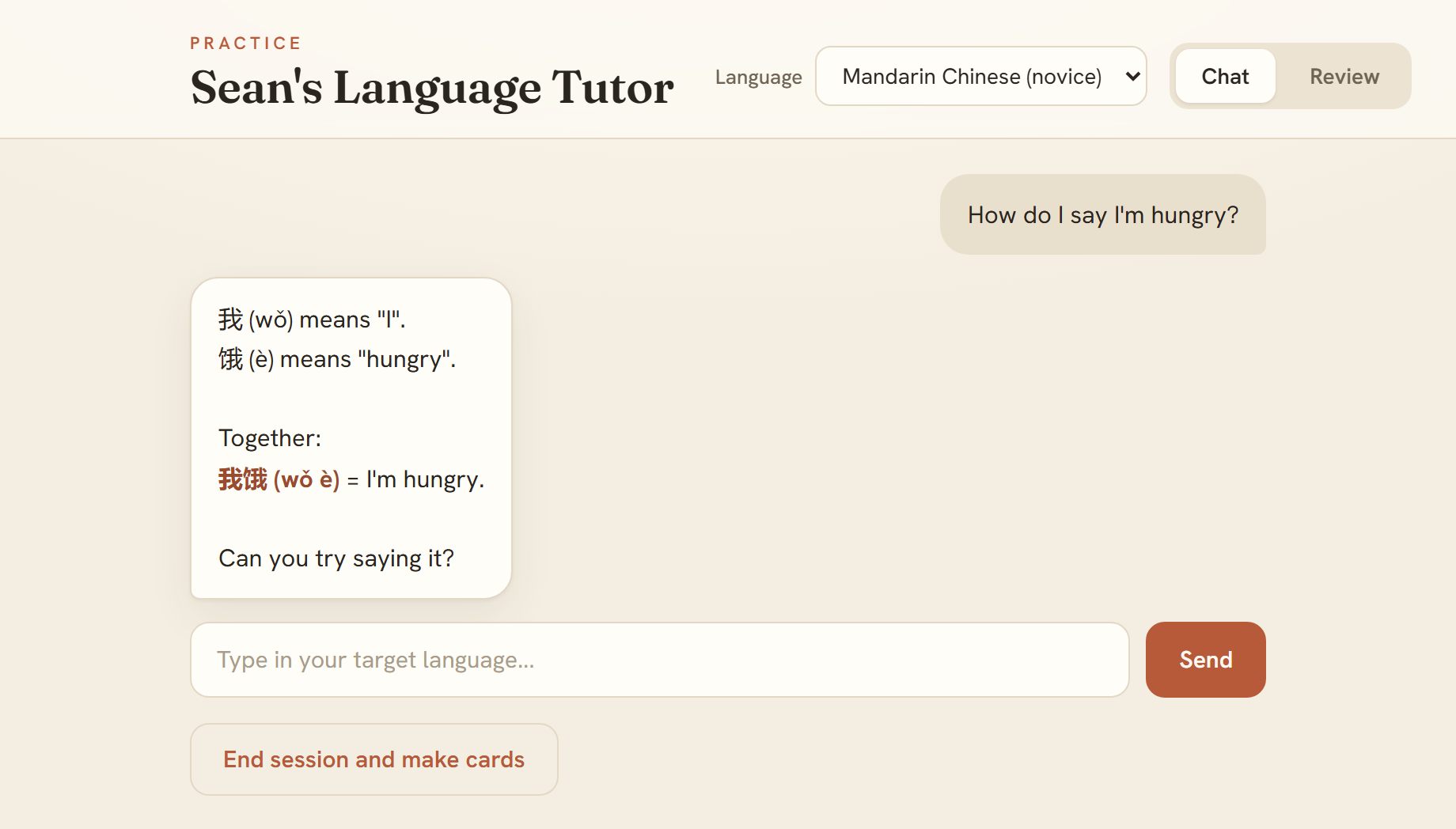
- A conversation tutor for Spanish, French, and Mandarin. It replies at my level: mostly Spanish for my B2, heavier scaffolding with English glosses and pinyin for the two I am starting from scratch. It corrects my mistakes with a one-line reason and keeps the conversation going.
- Flashcards that write themselves. At the end of a session it reads the chat, pulls the words I stumbled on or just met, and proposes cards with the term, its meaning, and the example sentence from my own conversation. I tick the ones worth keeping.
- Spaced repetition for review. Cards come back on an FSRS schedule, the same algorithm Anki uses, and how I grade each one decides when I see it next.
It all runs on my laptop. The API key and the deck stay on my disk.
How it works
- Pick a language and chat. A small web page on localhost sends the conversation to the model with a per-language tutor prompt that fixes the level and the script rules.
- Mine the session. When I end a session, a second prompt reads the transcript and returns a clean list of flashcard candidates as structured data.
- Save the keepers. The cards I approve go into a local SQLite file along with their scheduling state.
- Review on schedule. The FSRS library sets each card’s next due date from how I graded it, and the review tab serves whatever is due.
A few choices kept it small. The model sits behind a thin interface, so the free Gemini key it uses today could be swapped for a local, offline model later without touching the rest. The spaced-repetition half needs no AI at all, so my deck works offline and free forever. And the whole thing is local-first: one command, a browser tab, no accounts and no hosting.
What’s next
- Give it a voice. Speech in and speech out is the obvious next step, and honestly not a long jump from here. For Mandarin especially, tone is pronunciation, and text cannot teach that.
- The far end is sci-fi: a Star Wars style R2-D2 I can just turn on and talk to, a tutor that holds a real conversation with no screen at all. Voice first, robotics much later.
What I learned
You can build almost anything you can picture now. This exact tool was near the ceiling of what I could imagine a few years ago, and it took about an hour to put together. It really does feel like we are living in the future.
Status
Shipped. Running on my laptop. The next iteration is voice, not new screens.